
PRB vs PRSA: What’s the Difference and Which Should You Transfer To?
- Pension Advice
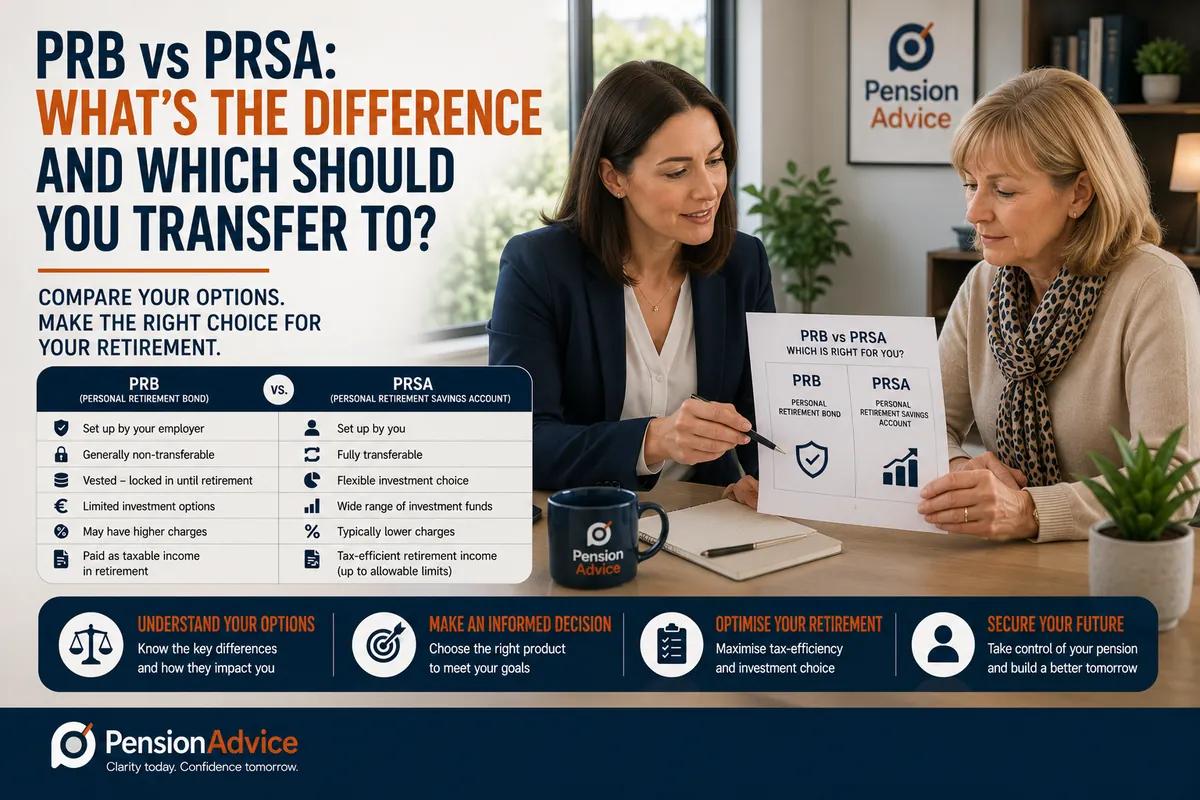
When you’re moving a pension out of a former employer’s scheme, you’re usually choosing between a Personal Retirement Bond (PRB), also known as a Buy-Out Bond, and a Personal Retirement Savings Account (PRSA).
They look similar on the surface: both take your pension out of your old employer’s hands and place it in a policy that belongs entirely to you. But the rules governing what you can do with each one, both now and in the future, are genuinely different.
Getting this choice right matters more than it might seem, since switching between the two later isn’t always straightforward. Here’s what actually separates them.
6 Key Differences
A PRB takes one transfer, and only one
A Personal Retirement Bond accepts a single transfer from an occupational pension. Once it’s in, you can’t add further contributions to that same policy.
PRBs are typically accessed from 50
In line with standard early access rules for transferred occupational pensions, a PRB can generally be accessed from age 50 onwards.
PRSAs can be vested from 50, if you have ceased all employment
A PRSA can grant early access or Vest from 50 if you have ceased all employment, if you are in employment or self-employment this increases to 60.
Both remove you from your former employer's scheme
Whichever you choose, the pension moves into your own name, independent of your former employer’s trustees and administration.
The right choice depends on what you'll do next
If you’re simply parking an old pension, a PRB is straightforward.
A PRSA may require a Statement of Benefit Comparison Report
If transferring from a Defined Benefit Pension Scheme a report called a Statement of Benefit Comparison may be required. This will incur an additional charge.
PRB vs PRSA at a Glance
PRB: generally from 50. PRSA: vested from 50 if not employed, 60 if employed.
Both: you select the funds from the provider’s range.
Both: entirely in your own name, independent of your former employer.
Both vary by provider — worth comparing quotes for your specific fund size.
What Happens on Death
Both structures generally allow the full value to pass to your estate or nominated beneficiaries if you die before accessing the pension, subject to the specific policy terms and any nomination you’ve put in place. This is one of the areas where it’s worth checking the detail with your chosen provider rather than assuming — nomination forms, in particular, are easy to overlook when a pension is first set up and then forgotten about for years.
Comparing Charges
Neither product type has a fixed, standard charge — both PRBs and PRSAs vary by provider and fund choice.
Not sure which one suits you? We’ll help you weigh up a PRB against a PRSA for your specific pension — at no obligation.
Important information: This article is for information purposes only and does not constitute financial advice. Rules are current as at July 2026 and subject to change. Always seek professional regulated advice before making decisions about your pension. Gen Z Financial Solutions Limited trading as Pension Advice is regulated by the Central Bank of Ireland.


Have a question about your pension?
Speak with a qualified advisor — no obligation, just clear guidance.
Related service
Gen Z Financial Solutions Limited trading as Pension Advice is regulated by the Central Bank of Ireland.
Frequently Asked Questions
What is the difference between a PRB and a PRSA?
A PRB (Personal Retirement Bond, also called a Buy-Out Bond) accepts a single transfer from an occupational pension. A PRSA (Personal Retirement Savings Account) can accept transfers and ongoing contributions. A PRB can be accessed from 50, whilst you may have to wait until 60 to access a PRSA.
Can I add contributions to a PRB?
No, a PRB only accepts one transfer in and cannot receive further contributions afterwards.
Which is better for consolidating an old employer pension, a PRB or PRSA?
Both can work — it usually comes down to when you are likely to access.
Can I access a PRSA while still working?
If you are over 60 and still working yes, if you are between 50 and 60 no.
What age can I access a PRB?
Generally from age 50, in line with standard early access rules for occupational pension transfers.
Are PRB and PRSA charges different?
Charges vary by provider for both product types.
Can a defined benefit pension go into a PRB or PRSA?
It’s possible in some cases, but transferring a defined benefit pension is a significant decision requiring specific specialist advice given the guarantees involved.
Do I need advice to choose between a PRB and PRSA?
Yes, since the right choice depends on whether you want ongoing contribution flexibility, your age, and your specific pension type.
Have a question about your pension?
Speak with a qualified advisor — no obligation, just clear guidance.